On this page
01 How it works
Think of the little games people play while waiting for the bus: stack the blocks, sort the colours, guide the ball through the maze. They’re called casual games. The simplest ones — one finger, one idea, a round in under a minute — are called hypercasual. A bit more depth, like upgrades or a small base to build, makes them hybrid-casual.
Most of these games are free. They earn money with ads (a short video between levels, a reward for watching one) and sometimes with in-app purchases (remove ads, extra lives, skins). Each player brings in only cents. So everything depends on getting players cheaply and keeping them for a while.
That’s where publishers come in. Companies like Voodoo, CrazyLabs, Kwalee or Supersonic test thousands of game ideas every year. You send them a prototype or a short gameplay video. They spend a small ad budget to see how cheaply people install it and how long they keep playing. If the numbers are good, they fund the marketing, help improve the game and split the profit with you. If not, you’ve lost a few days, not your savings.
- Idea
- Prototype
- Test video
- CPI test
- Publisher deal
- Launch

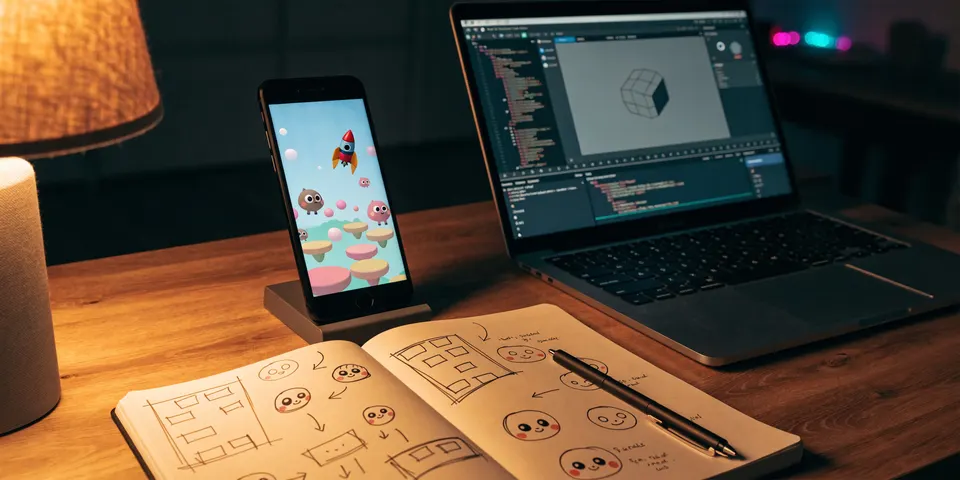
I’m tinkering on a game idea myself right now — a little rescue mission where you decide who gets the last seats on the rocket. More I won’t reveal yet. What surprised me most while researching: the code isn’t the bottleneck anymore. With AI I had a playable prototype faster than I could write the concept. The real question is whether strangers want to tap on it.
02 Is this for you?
- love playing and analysing simple games
- enjoy building, testing and throwing ideas away again
- can think in short videos: what makes someone stop scrolling?
- see it as a creative experiment with a small budget
- have a few evenings a week for several months
- need predictable income soon
- want to build one big dream game for years
- hate it when numbers say no to your favourite idea
- would spend your savings on ads to “force” a hit
- want to copy existing hits — publishers and stores reject clones
03 Why this is a yellow flag
Mobile games are a real business, and some small studios earn very well. But honestly, for an individual it works more like a lottery where you can improve your odds than like a plannable side income. Four reasons:
1. The hit rate is tiny
The publisher Freeplay once shared its numbers: in February 2020, 17 of around 350 tested prototypes became hits (about 4.8 %). In April 2021 it was 20 hits out of about 4,400 prototypes — roughly 0.45 %. The exact figures change every year, the message doesn’t: most games fail the very first test.
2. The margins are thin
A player of a hypercasual game is often worth only a few dozen cents. If an install costs more than a player brings in, every new player loses money. A few cents decide between profit and loss.
3. Hits don’t last forever
Many hypercasual hits earn well for a few months and then fade. Hybrid-casual games live longer, but they also take much more work.
4. Publishers take a big share
Revenue shares are negotiated individually and rarely published. One example from industry press: the publisher Ducky said in 2021 that it invests in hits and takes a 50/50 profit share. Typically profit is split after marketing costs — not revenue.
04 What AI changes
Publishers won because volume wins: the more ideas you test, the more likely one hits. AI tools make volume affordable for one person. A prototype that used to take weeks can now be playable in days.

05 Step by step — from idea to publisher test
All ten steps, nothing held back. Plan two to six weeks for your first test — and expect to need several attempts.
Casual games live on one clear mechanic. “Drag the creatures into the rocket before the lava reaches them.” If you need a paragraph, the idea is too big for a first game. Start hypercasual or light hybrid-casual — not a big role-playing game.
- Can someone understand it from a 3-second video?
- Does it work with one finger?
- Is there a satisfying moment (something fills up, pops, sorts, explodes)?
- Is it different enough from the top charts — not a copy?
Play the current top free games in the casual charts for a week and watch their ads. Publishers also blog about trends and what they look for. Let AI help you find patterns.
Choose an engine (Unity or Godot are common for mobile, see Tools) and let an AI coding assistant build the first version. Keep it tiny: one mechanic, three to five levels, no menus, no shop. Publishers say a CPI test needs only a few levels.
Game feel — the bounce, the sound, the little vibration — decides whether people keep playing. Add it before any test.
For many publishers the video is the first filter. 15–30 seconds, portrait, real gameplay, the hook in the first three seconds. Make three versions with different openings — a “fail” moment, a near miss, a very satisfying finish.
Most beginners go through a publisher: they pay for the tests and you get honest numbers for free. Testing on your own means paying for ads yourself, roughly a few hundred dollars per test, and you need a working ad account. That only makes sense if you want to keep all rights and profits.
Many publisher tests need your game in the stores, under your developer account. Plan this early, it takes time.
- Apple Developer Program: US$99 per year. For iOS builds you need a Mac with Xcode (or a cloud build service).
- Google Play Console: one-time US$25. New personal accounts must run a closed test with at least 12 testers for 14 days before they can publish.
- EU: Apple asks you to declare whether you are a “trader” under the Digital Services Act. If you earn money with the app, you usually are — and your address, phone number and email are then shown on the store page.
A test runs a few days. You’ll see three key numbers:
There are no universal thresholds. Kwalee calls the CPI test the fastest way to check potential; CrazyLabs says it looks at a range of metrics like day-1 retention and playtime and has no fixed CPI target. Industry reports put the median hypercasual CPI on Android at around US$0.40 in 2025, with iOS much higher.
Bad CPI? Try new videos or a new hook first, the game itself might be fine. Bad retention? Make the first minute clearer and more rewarding. If two or three rounds of changes don’t help, stop and start the next idea. The number of ideas you test matters more than how perfect one game is.
A good test usually leads to a deeper test and then an offer. Read it carefully — ideally with a lawyer.
- How is the profit split, and before or after marketing costs?
- Who owns the game, the code and the brand — and for how long?
- Exclusivity, minimum updates, what happens if the publisher stops marketing?
- Ads in the EU/UK: AdMob, for example, requires a Google-certified consent tool for personalised ads.
- Taxes: income from the publisher is business income — talk to a tax adviser.
06 Tools
You don’t need much to start. Build with a free engine, let AI write the code, and only pay for store accounts once you’re ready to test.
07 Realistic expectations
Let’s be clear: there is no meaningful “average” income. Most games earn nothing; a few earn a lot. Small successes of a few thousand dollars profit a month can be great for one developer — and are often too small for a big publisher to keep marketing. Real top hits can make six or seven figures, but they are rare.
Why cents decide everything — a worked example
Invented but realistic numbers. A few cents per player decide between profit and loss — that’s why publishers test so strictly, and why the test numbers are more honest than any opinion.
08 Tips & common mistakes
- Do: Build small and fast: one mechanic, a few levels, test within weeks.
- Do: Spend real effort on the first three seconds of your video.
- Do: Test several ideas in parallel instead of polishing one for months.
- Do: Read publisher terms (exclusivity, rights) before you upload.
- Avoid: Building a big game with menus, shop and story before the first test.
- Avoid: Cloning a chart hit — stores and publishers reject copies.
- Avoid: Paying your own ads before you know the numbers from a free publisher test.
- Avoid: Using AI art or music without checking the licence for commercial use.
09 Pros & cons
- AI makes prototypes possible for non-programmers
- Publishers pay for tests and marketing
- Low start costs
- Very creative, and fun
- Skills transfer to apps and other digital products
- Most games never earn anything
- Thin margins, hits often short-lived
- Publishers take a large share and may want exclusivity
- Store rules, privacy and ad consent take effort
- Months of work can end with “no”
10 Risks & legal
- Copyright & trademarks: no copied names, characters or art. AI-generated assets: check the tool’s licence for commercial use.
- Privacy: both stores require privacy details (Apple’s privacy labels, Google’s data safety section) and a privacy policy. Ads in the EU/UK need consent.
- EU trader status: if you earn money, your contact details are shown publicly in the EU App Store. A company address can help.
- Store fees: for in-app purchases Apple charges 15 % in its Small Business Program (under US$1 million a year). Google changed its fees on 30 June 2026 for the EU, UK and US: in-app purchases from new installs 20 % plus a 5 % billing fee on the first US$1 million (subscriptions 10 % + 5 %); in other markets 15 %. Ad revenue is not subject to these store fees.
- Kids: games aimed at children have strict extra rules for ads and data. Avoid that audience for your first game.
- Contracts & taxes: get publisher contracts checked, and register the income properly.
General information only, not legal or tax advice. Rules and fees change — always check the official pages of Apple, Google and your publisher before you sign or submit.
11 FAQ
Can AI build a whole mobile game for me?
AI can write most of the code for a simple casual game and help with art drafts, texts and bug fixes. You still decide what’s fun, test on real phones and polish the feel. For a first prototype that’s days of work, not months.
Do I need to be able to program?
Not to start. You need to describe precisely what should happen and be willing to test a lot. Over time you’ll pick up the basics just by reading what the AI writes and asking it to explain.
Do I need a Mac?
For Android, no. To build and upload for iOS you need a Mac with Xcode or a cloud build service.
How much can I earn?
Honestly: most games earn nothing, a few earn a lot. There’s no reliable average. Treat it as a creative experiment with a small budget, not as planned income.
Do I need a publisher?
No, but for beginners it’s usually the smarter route: publishers pay for tests and marketing and know what works. Going alone means paying for ads yourself and keeping all rights and risks.
Do Apple and Google take a cut of my ad revenue?
No. Store fees apply to paid apps and in-app purchases. Ad revenue comes through the ad network you use.
The Casual Game Prototype Kit
- Idea check: 10 questions before you build
- AI prompt pack for prototype, game feel & bug fixing
- Store checklist: Apple, Google & EU trader status
- Publisher overview & pitch template
- CPI & profit calculator with worked example
- Storyboards for 3 short test videos