On this page
01 How it works
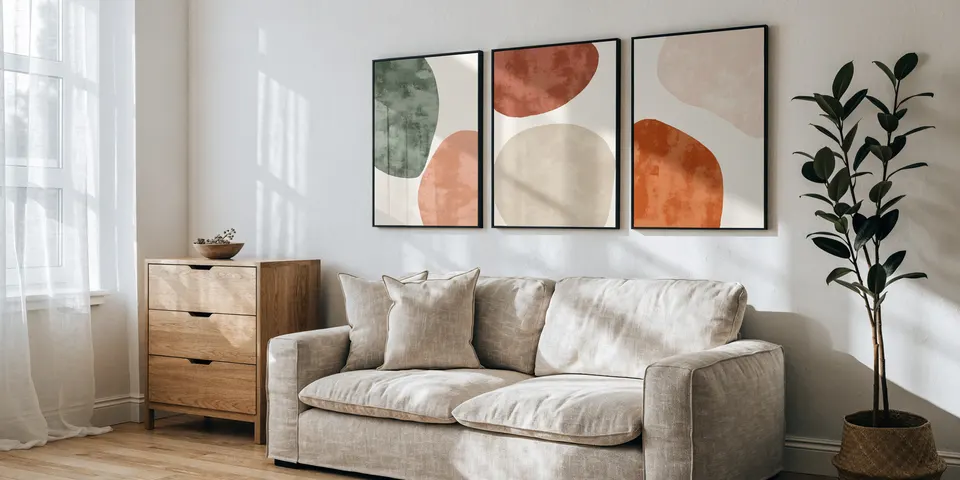
People don’t buy “a picture”. They buy something that makes a room feel finished. A young couple furnishing their first flat wants three prints that match their beige sofa. A mum wants calm, soft art for the nursery. Someone who just painted a wall dark green wants art that works with that green. That’s the job you do: you create small, cohesive art collections for a specific room and style — and sell them in two ways.
First, as digital downloads: the buyer pays, downloads high-resolution files and prints them at home, at a local print shop or online. Second, as physical prints through print-on-demand (POD): a print company prints each order on real art paper or canvas, sometimes framed, and ships it directly to your customer. You never touch stock, frames or parcels.
- Find a room & style niche
- Define the collection
- Generate with AI
- Upscale for print
- Room mockups
- List & sell
Three business models, one skill set:
02 Is this for you?
- love interiors, colours and scrolling through beautiful rooms
- have a sense for what matches — or want to train it
- enjoy curating: picking the best 3 out of 60 images
- want a visual business without drawing or painting yourself
- are happy to build a catalogue step by step over months
- need money this month
- think “upload a few AI pictures and wait” is a business
- don’t want to check files at 100% zoom for AI glitches
- plan to copy famous artists or their styles
- have no patience for listing photos, titles and keywords
03 The “saturated” myth — where the money really is
Search Etsy for “wall art” and you’ll get more results than you could ever scroll through. Many people stop right there: “Too late, everyone is doing AI art.” That’s the wrong conclusion. Most of those listings are random single images — a nice picture, no clear buyer, no clear room, mockups that all look the same. That’s not competition. That’s noise.

I started in print-on-demand in 2018, when everyone already said it was saturated. It never was. The winners are always the ones with a sharp niche, design people trust and the discipline to keep going.
The money sits in three places:
- A sharp room-and-style niche — not “abstract art”, but “terracotta and sage abstract set for a boho living room”. Buyers search like that, because they’re decorating a real space.
- Cohesion and quality — a set of three that truly belongs together: same palette, same texture, same mood. Clean, sharp files that look good even printed large. This is where a designer’s eye beats volume.
- Consistency — a recognisable shop look, new collections every week or two, seasonal refreshes. Buyers who liked your nursery set come back for the kids’ room.
Broad vs. sharp: what a good niche looks like
04 What AI changes
Wall art used to mean one of two things: you painted or photographed yourself, or you licensed artwork from others. Building a catalogue of 50 matching collections was a year of work. Today AI image tools create painterly, photographic or illustrated artwork in minutes — and they’re very good at exactly what wall art needs: mood, colour and texture. The biggest barrier is gone.
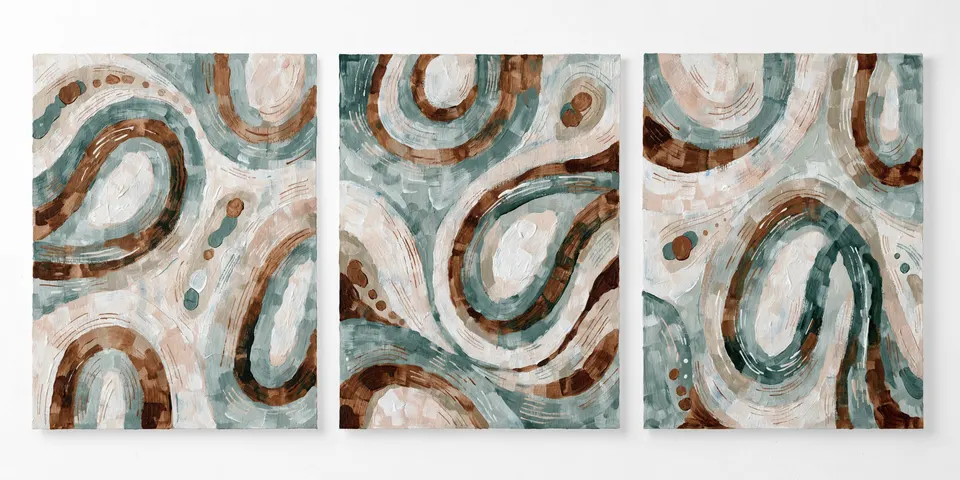
Where AI still needs you: it adds strange details (melted hands, random letters, half-objects in the background). It changes the style slightly from image to image, which ruins a set. Its raw files are often too small for large prints. And it has no idea which room, colours or sizes people actually buy. That part is your work — and it’s why this business rewards taste and care, not just clicks.
05 Step by step — the complete process
All ten steps from zero to collections that sell as downloads and as real prints. Plan roughly two to four weeks for your first ten collections if you work on it a few evenings a week.
This decides most of your result. Honestly: think in rooms and interior styles, not in pictures.
- Type ideas into the Etsy and Pinterest search bars (“nursery wall art neutral”, “kitchen prints vintage”) and note the autocomplete suggestions — those are real searches.
- Open the top results. Look at reviews and sales signals: several shops selling steadily in one niche means real demand.
- Read the reviews. “Colours looked different”, “file was blurry at A2”, “sizes missing” — every complaint is your opportunity.
- Check Pinterest for interior trends: paint colours, styles (Japandi, boho, mid-century, cottagecore, coastal), seasonal looks.
Write a one-page brief for each collection. This is what makes your work look like a brand instead of a random mix:
- Room & buyer — e.g. “neutral nursery, parents who like calm, natural looks”.
- Palette — 3 to 5 colours, ideally matching popular paint and furniture tones.
- Medium & texture — watercolour, gouache, line art, film photo, textured canvas.
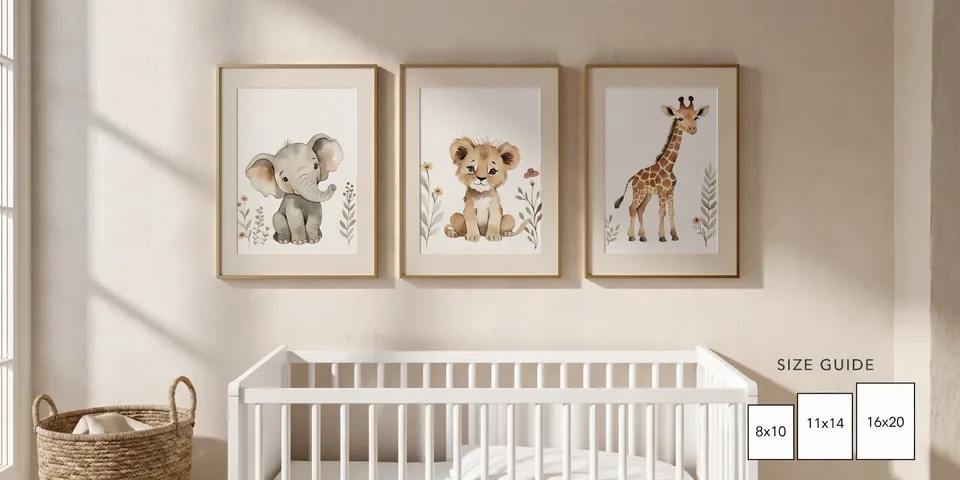
- Subjects for the set — e.g. elephant, giraffe, lion — same pose style, same framing.
- Format — portrait or landscape, and which ratios you’ll deliver (see step 5).
Build one master prompt for the collection and only change the subject. Use your tool’s style or image references (many tools let you upload a “style reference”) so all pieces share the same look. Generate plenty of options and keep only the ones that truly belong together.
Look at your favourites side by side, small and large. Would these three hang happily on one wall? If one feels louder, brighter or differently textured, replace it.
- Zoom to 100% and fix AI mistakes: odd hands and paws, fake letters, smudged corners, unwanted signatures.
- Match colours across the set in an editor (Photoshop, Affinity Photo, Photopea) so the greens really are the same green.
- Remove anything that looks like a logo, a watermark or a real brand.
Raw AI images are usually far too small for a large poster. An AI upscaler enlarges them while adding clean detail. For crisp prints, aim for roughly 300 DPI (dots per inch) at the final print size. Very large posters, viewed from a distance, can get away with less — but blurry or pixelated edges are the number one complaint.
For digital downloads, deliver one file per ratio so buyers can print almost any size. Crop each ratio by hand — don’t let the edge cut through the main subject. Export as high-quality JPG (and optionally PDF), sRGB colour.
Order a few test prints from your POD partner and print one file at home or in a local copy shop. Screens are bright. Paper is not — and that surprises almost everyone the first time. You’ll see if colours turn muddy, if dark areas lose detail or if texture looks fake at large size. Adjust once, and your whole catalogue benefits.
And buyers want to see art on a wall, in a room like theirs. Use mockup tools or photos of real rooms — and AI-generated interiors are fine for this too. The rule: the artwork in the mockup must be your real file, in realistic proportions. Don’t make a small print look like a giant canvas.
- Main image: the full set of 3 in a styled room matching the niche.
- Close-up: one piece, so buyers see texture and detail.
- Size guide: the art next to a sofa or a person, with sizes labelled.
- For downloads: an image that explains “digital file, no physical item is shipped” and lists the included ratios.
- Write titles the way buyers search: room + style + subject + “set of 3” + “printable” or “print”.
- Use all tag slots with real search phrases from step 1. No artist names, no brand names.
- State clearly in the description that the artwork was created with the help of AI. Etsy requires sellers to disclose AI use in the listing.
- For downloads: list the ratios and file sizes, explain how to print, and state that no physical item ships.
- Your own shop (e.g. Shopify, Payhip, Gumroad) lets you build a brand and an email list. Many sellers start on Etsy for the traffic and add their own shop later.
- Connect a POD service such as Printful, Printify, Gelato or Prodigi to your shop. They print posters, fine art prints, canvas and framed art and ship to the customer.
- Pick paper quality and frames that match your price level — and order samples of each.
- On Etsy, name your print partner as a production partner and show where the item ships from. This is required.
- Check realistic production and shipping times and put them in the listing. Honest delivery times prevent bad reviews.
- Pinterest is the natural home of wall art: pin every mockup, link to your listings, pin consistently.
- Ask early buyers for honest reviews — never buy reviews.
- Watch which rooms and colours sell, then build more collections there: a second nursery palette, a matching kids’ room, a seasonal refresh.
- Bundle: “gallery wall set of 9”, “seasonal refresh pack”, “entire home in one palette”.
06 Tools
Start with research — it matters more than any image tool. Everything else you can swap later.
07 Realistic expectations
Honestly: a single collection rarely sells much on its own. Many listings sell nothing for weeks, a few become steady sellers — and you can’t predict which. The shops that do well treat it like a small art brand: a clear look, dozens of collections in a few niches, strong mockups, steady Pinterest work and physical prints as a second leg next to downloads. Demand also moves with the seasons (moving season, New Year “fresh start”, Christmas gifts), so judge your results over months, not days.
08 Tips & common mistakes
- Do: Sell sets that belong together — same palette, texture and mood. Cohesion is what people pay for.
- Do: Upscale properly and deliver every common ratio. “Works in any frame” is a buying reason.
- Do: Show the art in a room that matches the niche, plus a close-up and a size guide.
- Do: Order test prints. Fix colours once, before hundreds of listings go live.
- Avoid: Uploading raw, small AI files that look blurry once printed large.
- Avoid: Using living artists’ names in prompts, titles or tags.
- Avoid: Mockups that make a small print look huge or show colours your file doesn’t have.
- Avoid: Hundreds of random single images with no niche, no set and no brand.
09 Pros & cons
- Very low start costs, no stock
- AI removes the need to paint or license art
- One collection sells as download and as print
- Evergreen demand: people move, renovate and gift
- Easy to grow into a recognisable brand
- Lots of low-effort AI art around — you must stand out
- Upscaling, mockups and listings take real time
- AI images have weak copyright protection
- Depends on Etsy’s and POD partners’ rules
- Single listings rarely earn much alone
10 Risks & legal
- Copyright of AI images: In the US, the Copyright Office says copyright needs human authorship. Prompts alone are not enough, so a purely AI-generated image is generally not protected. Your own creative input can be — for example clear edits you make and the creative selection and arrangement of a collection. In March 2026 the US Supreme Court declined to hear the leading case on this (Thaler v. Perlmutter), so the human-authorship rule stands. Other countries follow similar lines, but details differ. In practice: others may copy pure AI images, so your brand, cohesion and customer trust are your real protection.
- No style copying of artists: Don’t prompt “in the style of” living artists and don’t use their names in titles or tags. Never upload other people’s artwork as a reference to recreate it.
- Trademarks & characters: No brand logos, movie characters, sports teams or celebrity likenesses — not in the art, not in the keywords.
- AI disclosure: Etsy requires sellers to disclose in the listing when an item was created with AI, and it allows AI art only when it’s based on your own prompts and creative input. Selling bare prompt bundles is not allowed.
- Production partners: On Etsy, physical prints made by a POD service must be listed with that production partner and honest shipping information.
- Honest listings: Mockups must show your real artwork at realistic sizes. Digital downloads must be clearly marked as files, not physical products.
- Taxes & consumer rules: Sales are income. Digital products in the EU and UK can come with VAT rules and special rules on withdrawal rights. Check what applies to you where you live.
General information, not legal advice.
11 FAQ
Do I need to be able to paint or draw?
No. AI creates the artwork. What you need is a good eye: choosing pieces that belong together, spotting mistakes and matching colours. That can be learned.
Can I sell AI art on Etsy?
Yes, as long as it’s based on your own prompts and creative input, and you disclose the AI use in the listing. Physical prints made by a POD service must be listed with that production partner.
Do I own the copyright to my AI art?
Only partly. In the US, pure AI output generally isn’t protected — your own creative additions, edits and the arrangement of a collection can be. You can still sell the images; just don’t rely on copyright as your main protection.
Digital downloads or physical prints — where should I start?
Start with digital downloads: no production, instant delivery, fast learning. Add physical prints via POD once you know which collections sell — same artwork, second channel.
How big can I print an AI image?
Raw AI files are usually only good for small prints. After proper AI upscaling, large posters are realistic. Aim for around 300 DPI at the final size and always check a test print.
The AI Wall Art Kit
- 50 room & interior-style niches with a clear buyer
- Style-lock prompt template for matching sets of 3
- Print size & ratio cheat sheet (inches, cm, A-sizes)
- Upscaling & print-quality checklist
- Mockup shot list: what every listing needs
- Etsy listing template incl. AI & production partner notes