On this page
01 How it works
Print-on-demand (POD) means a product is only printed after a customer has paid for it. You open a shop on Etsy, the marketplace for creative and personal products. Then you connect it to a POD partner such as Printful, Printify or Gelato. These companies have printers and blank products — T-shirts, hoodies, mugs, posters, tote bags, phone cases — in production sites around the world.
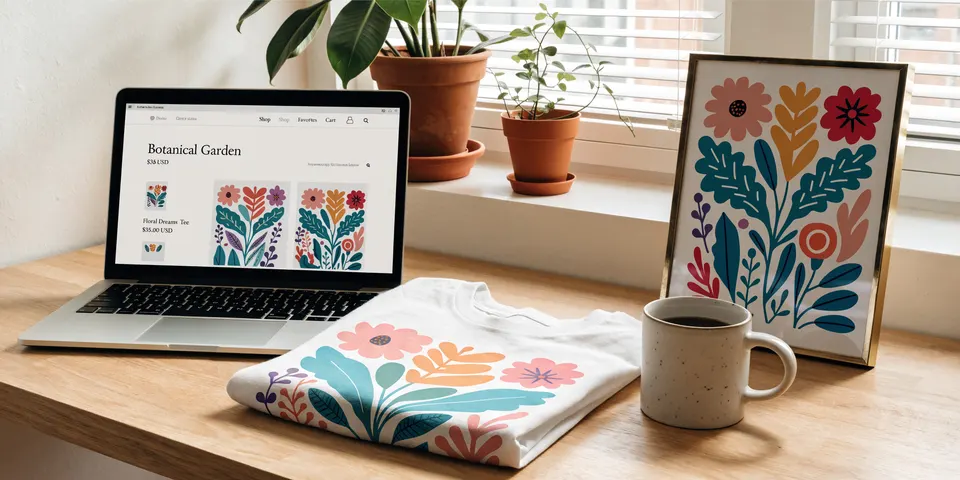
You upload your design to the partner, place it on a product and create mockups (realistic preview images of the product with your design). The partner’s app sends the finished listing to Etsy. When a buyer orders, the order jumps automatically to the partner. They print, pack and ship it under your shop’s name. You keep the difference between what the buyer pays and what the partner charges you, minus Etsy’s fees.
- Find a niche
- Create designs
- Connect POD partner
- Mockups & samples
- Etsy listing & SEO
- Partner prints & ships
Three ways to build it:
02 Is this for you?
- like design, words and funny or heartfelt ideas
- want a real shop without buying stock or shipping parcels
- enjoy researching what people search for and buy
- can answer customer messages kindly and quickly
- are happy to build step by step, design by design
- need money this month
- want to upload 500 random designs and wait
- can’t stand a customer asking “where is my order?”
- want to use famous brands, movies or band names
- expect Etsy to bring buyers without any work on titles and tags
03 The “saturated” myth — where the money really is
Search Etsy for “funny t-shirt” and you’ll find a huge number of results. That’s where most beginners decide it’s too late. But nobody buys “a funny t-shirt”. A buyer searches for a gift for a grandpa who fishes, a shirt for a night-shift ICU nurse, a mug for a new beekeeper. Each of these is a small market of its own — and in many of them the top results are dated, ugly or badly worded.

I started print-on-demand in 2018, when everyone already said it was saturated. It wasn’t then and it isn’t now. The ones who win do three things: they find a sharp niche, they make designs people are proud to wear or give, and they keep going.
The money sits in three places:
- A sharp niche — a specific group of people with a strong identity: a job, a hobby, a family role, a place, a life event.
- Design quality — clean type, a real idea, good colours on the product. Etsy buyers are used to handmade quality and compare closely.
- Consistency — a shop that serves one audience with many good designs looks trustworthy and earns repeat buyers.
Broad vs. sharp: what a good niche looks like
04 What AI changes
Print-on-demand used to need three things: design skills (or money for a designer), a camera setup for product photos, and hours of writing for every listing. AI now takes over a big part of all three.
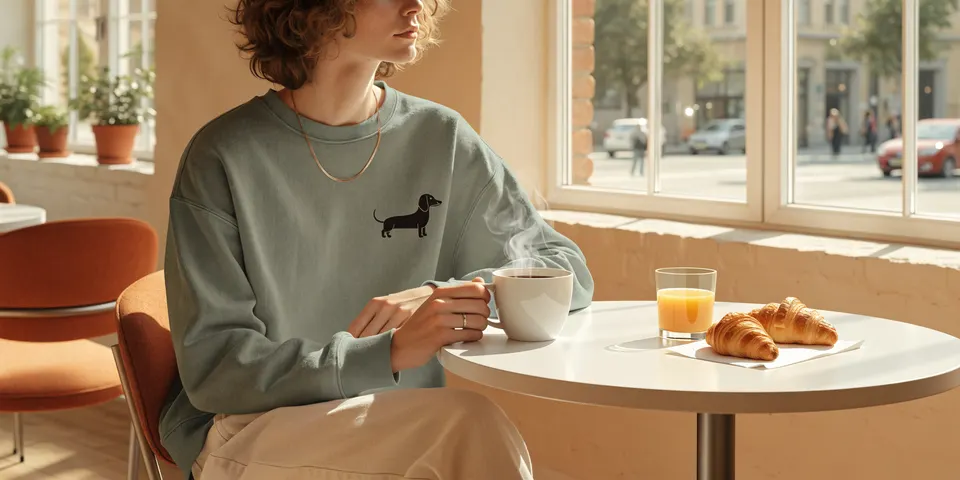

Where AI still needs you: it doesn’t know which niche sells. It writes weak jokes if you don’t steer it. AI images can contain odd details and blurry edges that look bad when printed large. And AI text in images is often misspelled. Good design on a shirt is usually simple: a clear idea, good lettering, the right colours for the fabric. That part is your job.
05 Step by step — the complete process
All ten steps from zero to a working Etsy shop with a POD partner. Plan roughly three to five weeks for the first launch if you work on it a few evenings a week.
This is the most important step. Honestly, spend real time here before you design anything.
- Type ideas into the Etsy search bar and note the autocomplete suggestions — those are real searches.
- Open the top results. Look for listings with many reviews and shops with steady sales — that means real demand.
- Read reviews of competitors. “Print faded”, “smaller than expected”, “boring design” — every complaint is a chance for you.
- Pick one audience for your first 20–30 designs. Don’t jump between ten niches.
- Choose a shop name that fits your audience, not a random word.
- Write a short About section: who you are, who you design for, and that your products are printed by a production partner.
- Set up your shop policies for returns, damaged items and personalisation. Clear rules prevent arguments later.
- Add a simple logo and banner. Canva is enough.
Printful, Printify and Gelato all offer an Etsy integration: you connect your shop once, and listings and orders sync automatically. Compare them on three things, not just price:
- Product quality — which blank shirts, mugs and paper they use.
- Production location — close to your buyers means faster, cheaper shipping. Gelato and Printify route orders to printers in many countries.
- Shipping times — they decide your Etsy delivery estimates and your reviews.
Aim for 10–20 designs for your first launch, all for the same audience. Mix text-based designs (slogans, lettering) with illustrated ones. Keep the design simple enough to read from two metres away.
- Use AI for the idea or the artwork, then set the text yourself in Canva, Affinity or Kittl — AI lettering is often misspelled.
- Export at the partner’s recommended size and resolution, with a transparent background for apparel.
- Make light and dark versions so the design works on different shirt colours.
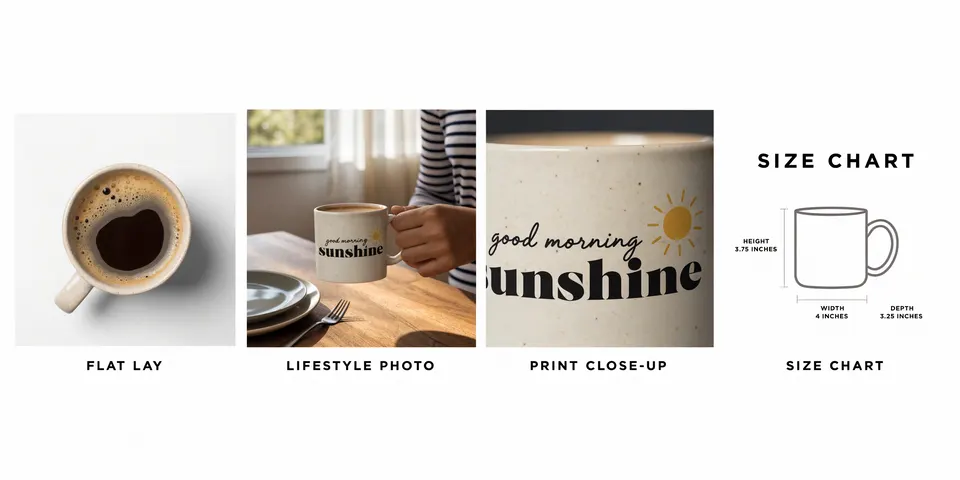
Your photos sell the product. Plan five to eight images per listing:
- A clean product shot on a plain background.
- A lifestyle image: someone wearing or using it, in a scene that fits the buyer (AI scenes or mockup tools work well).
- A close-up of the design, a size chart and a colour chart.
- A real photo of your sample — this builds trust and follows Etsy’s advice to show the actual item.
Order your best designs for yourself before you promote them. I always do — a print can look very different in real life. Most partners offer sample orders. Check print quality, colours, size of the print, how the fabric feels and how it looks after washing. Now you know what the buyer gets — and you have real photos. Skipping this is how shops end up with “looks nothing like the picture” reviews.
SEO (search engine optimisation) means wording your listing so Etsy shows it to the right searchers. Etsy looks mainly at your title, your tags and your attributes (colour, occasion, recipient and so on).
- Title: start with what the product is and who it’s for, in the words buyers type: “Dachshund Mom Sweatshirt, Minimalist Dog Lover Gift”. Readable, not a keyword pile.
- Tags: use all the tag slots Etsy gives you with short phrases buyers really search: occasion, recipient, style, hobby.
- Attributes: fill in every relevant one — they work like extra free tags.
- Description: first two lines = what it is and why it’s a great gift. Then size, material, care, shipping time. Mention the production partner and, if used, AI.
- In each listing, add your POD company as a production partner. You can show its name or a descriptive title such as “Apparel printer”. Buyers can also see your partners in your shop’s About section.
- Choose the correct “who made it” option: your design, produced by a partner — never claim you made it by hand.
- If a design was created with AI tools, say so in the listing description. Etsy’s Creativity Standards ask for this.
- Set realistic processing and delivery times from your partner’s real numbers.
And Etsy rewards shops with good reviews and fast replies. Your partner prints and ships, but the buyer talks to you.
- Answer messages within a day. Prepare friendly templates for “Where is my order?”, “Wrong size”, “Damaged item” and “Can you change the text?”.
- Check personalised orders for typos before they go to print.
- If a product arrives damaged or misprinted, most POD partners replace it — learn their claim process before you need it.
- Solve problems generously. One happy buyer is worth more than the cost of one replacement.
- Publish your first batch, then add new designs every week for the same audience.
- Check Etsy stats: which listings get views but no sales? Improve their photos, title and price.
- Share designs on Pinterest and in groups where your audience hangs out (without spamming).
- Test Etsy Ads carefully on your best sellers with a small daily budget.
- Turn winners into more products: the same design on a mug, poster and tote bag.
06 Tools
Start with research — it matters more than any design tool. The rest you can swap later.
07 Realistic expectations
Honestly: most new Etsy POD shops sell little in the first weeks. Many listings never sell at all, and a few designs bring most of the sales — you can’t predict which. Margins per item are smaller than with your own stock, because the partner prints each piece individually. The people who do well treat it like a real small brand: one clear audience, many good designs, real photos, fast service, and they keep improving titles and tags. Sales are strongly seasonal — autumn and the weeks before Christmas are the busiest — so judge your results over a full year.
08 Tips & common mistakes
- Do: Build a shop for one audience. It looks trustworthy and makes every new design easier.
- Do: Order samples of your best sellers and use real photos alongside your mockups.
- Do: Write titles and tags in the words buyers really type — check the Etsy search bar.
- Do: Plan seasonal designs months ahead. Christmas shoppers start early.
- Avoid: Using brand names, movie quotes, sports teams or celebrities. That leads to takedowns and can close your shop.
- Avoid: Hiding that a partner makes your products or that you used AI. Etsy asks you to disclose both.
- Avoid: Mockups that don’t match reality — wrong colour, huge print, a product your partner doesn’t offer.
- Avoid: Ignoring messages or setting delivery times shorter than your partner can deliver.
09 Pros & cons
- No stock, no printer, no packing
- Low start costs, low risk per design
- Etsy brings buyers who look for gifts and personal items
- AI speeds up ideas, artwork, mockups and listings
- One design works on many products
- Smaller margin per item than own stock
- Shipping times and print quality depend on your partner
- You handle customer service for problems you didn’t cause
- Etsy fees and rule changes
- Seasonal ups and downs
10 Risks & legal
- Trademarks & copyright: No brand logos, sports teams, movie or TV references, song lyrics, celebrity names or famous characters — not in designs, titles or tags. Even common phrases can be registered trademarks. Check a trademark database before you publish a slogan.
- Production partner disclosure: Etsy allows POD, but you must add your partner to each listing where it helps make the item. Claiming “handmade by me” for partner-printed items breaks Etsy’s rules.
- AI disclosure: Etsy’s Creativity Standards ask you to state in the listing description when an item was created with AI. Hiding it can cost you your shop.
- AI and copyright ownership: In many countries purely AI-generated images may not be protected by copyright, so others could copy them. Your own text, layout and editing add your work.
- Honest photos: Mockups must match what the buyer receives. Misleading images lead to returns, bad reviews and cases.
- Consumer rules: In the EU and UK, buyers have rights for online purchases (e.g. returns for non-personalised items, refunds for faulty ones). Set clear shop policies.
- Taxes & business registration: Sales are income, and VAT rules may apply depending on where you and your buyers are. Check what applies to you.
General information, not legal advice.
11 FAQ
Is print-on-demand allowed on Etsy?
Yes. Etsy allows items that you design and a production partner makes. You must name that partner in your listings and be honest about who makes the product.
Can I sell AI-created designs on Etsy?
Yes, as long as they are your own creations and don’t copy others. Etsy asks you to state in the listing description that the item was created with AI.
Can I use mockups instead of real photos?
Yes, mockups are widely used. They must show the product exactly as the buyer gets it. Etsy recommends showing the actual item first, so add a real photo of a sample when you can.
Printful, Printify or Gelato — which is best?
None is best for everyone. Order samples from two partners with the same design and compare quality, shipping time to your main buyer country and cost. Then stick with one to start.
How many designs do I need?
Start with 10–20 good designs for one audience. Then add new ones regularly. Quality and a clear niche beat hundreds of random uploads.
The Etsy POD Starter Kit
- 50 sharp Etsy niche ideas, pre-checked
- Listing title & tag template
- Design prompt pack for shirts, mugs & posters
- Mockup shot list (what to show, in which order)
- Production partner & AI disclosure checklist
- Customer service reply templates