On this page
01 How it works
A non-fiction how-to book is simple at its core: one reader, one problem, one clear path to a solution. Think “How to pass your driving theory test the first time”, “Your first year as a freelance bookkeeper” or “Raised garden beds for complete beginners”. Not a 400-page masterpiece — a focused guide of often 80 to 200 pages that someone buys because they need an answer this week.
You pick the problem, gather what you know (and what you need to research), and build the book with AI as your assistant: it helps you research, structure the chapters, write first drafts and polish the language. You check every fact, add your own experience and examples, and make it sound like you. Then you publish it on Amazon KDP (Kindle Direct Publishing) as an e-book and a paperback. Amazon prints each copy only when someone orders it, ships it and pays you a royalty. No stock, no print run, no publisher.
- Find a reader problem
- Validate demand
- Outline with AI
- Draft + your expertise
- Fact-check & edit
- Cover & layout
- Publish & promote
The same skills give you three ways to earn:
02 Is this for you?
And no, you don’t need to be a “writer”. You need to know something useful — from your job, a hobby or a problem you solved yourself — and the patience to explain it clearly.
- have job or life experience other people struggle with
- like explaining things step by step
- are happy to check facts instead of trusting a machine
- can wait a few months for the first real results
- want a product that keeps selling without your time
- need money this month
- want AI to write the whole book while you watch
- don’t want to learn anything about your topic
- hate the idea of promoting your own work
- plan to write about medicine, law or money without real expertise
03 The “saturated” myth — where the money really is
Search “self help” or “productivity” on Amazon and you’ll feel tiny. Millions of books. Big publishers. Famous names. That’s where most beginners give up — and it’s the wrong place to look anyway. Nobody buys “a productivity book”. People buy a book for their situation: a new manager who has to lead former colleagues, a nurse switching to night shifts, a 55-year-old learning to use a smartphone.
Daniel Vice has coached self-publishers on Amazon KDP since 2017 and started with print-on-demand in 2018 — when everyone already said it was too late. His experience: markets are never “full”. They are full of average books. Money in this category sits in three places:
- A sharp problem — a specific reader with a specific pain, where the top books are few, outdated, too long or badly reviewed.
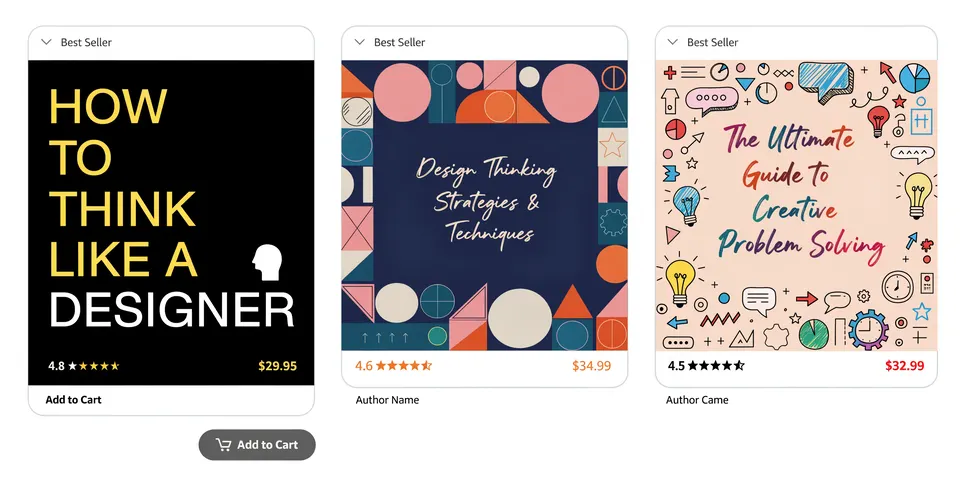
- A cover and title that win the thumbnail — on Amazon your cover is a stamp-sized image next to dozens of others. It must say “this is exactly for you” in one second.
- Consistency — book two and three on the same topic sell book one. Readers who liked your first guide look for the next.
Broad vs. sharp: what a good topic looks like
04 What AI changes
Writing a practical guide used to take many months: research in libraries and forums, sorting notes, staring at a blank page, rewriting, paying an editor and a cover designer. For most people with real knowledge, that was the barrier. AI removes most of the grind — not the thinking.
AI images are a real win here too: diagrams, chapter illustrations and cover visuals that once meant hiring an illustrator can now be created in minutes, in one consistent style. The only rule: an image must show things as they really are and must not mislead the reader.
There’s a second reason your own contribution matters: anyone can now generate a generic guide in an afternoon. What they can’t generate is your experience — the mistake you made in your first year, the shortcut your colleagues use, the example from real life. That’s what makes a reader recommend your book instead of returning it.
05 Step by step — the complete process
All ten steps, from zero to a published guide. Plan roughly six to ten weeks for your first book if you work on it a few evenings a week.
Start with what you know — that’s where I started too. List your jobs, hobbies, life changes and problems you solved. Then look for places where people ask about those topics.
- Type phrases into the Amazon search bar and note the autocomplete suggestions — those are real searches.
- Browse Reddit, Facebook groups and forums. Questions that come up again and again are book topics.
- Write down the exact words people use (“I’m overwhelmed”, “where do I even start”). They go into your title and description later.
Spend real time here — the topic decides most of the outcome.
- Open the top 10 books for your main search phrase. Check the Best Sellers Rank on each: if several sell steadily, there is demand.
- Read the 2- and 3-star reviews. What readers miss (“too basic”, “outdated”, “no real examples”, “written by AI”) is your angle.
- Look at publication dates and covers. Old, generic or cluttered top books mean a modern, clear book has a real chance.
- Check that the topic can’t be fully answered by one free web page. Readers pay for structure, depth and a path.
Write one sentence: “This book helps [reader] to [result] without [pain].” Example: “This book helps new team leads run their first one-to-one meetings with confidence, without copying a management textbook.” Every chapter, example and cover decision gets checked against it.
Your title follows from it: result + reader + (optional) timeframe, e.g. “The First-Time Team Lead: 30 Days to Confident One-to-Ones”.
Use AI to map the topic: common questions, typical mistakes, the order in which beginners need information. Ask for sources — and then actually open them. Use official websites, respected organisations and books you trust for anything factual.
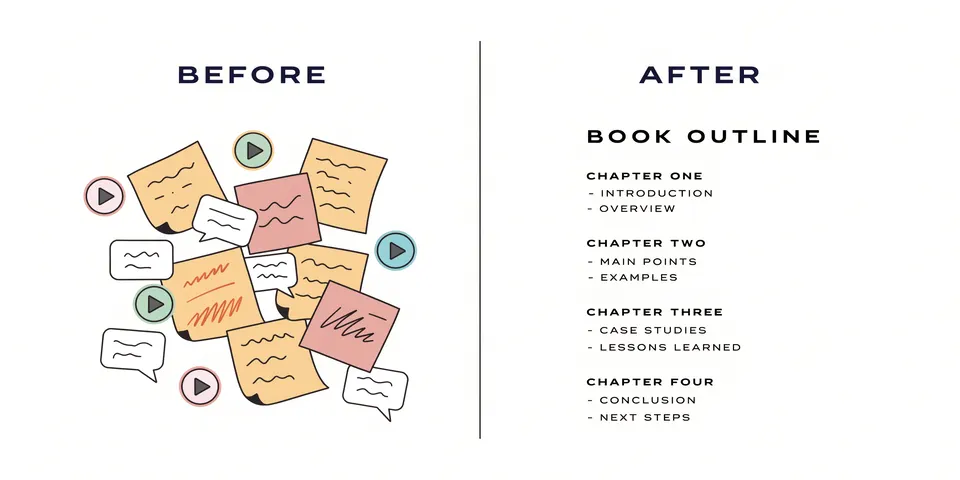
Aim for 8–15 chapters that follow the reader’s journey from “I’m stuck” to “I did it”. Each chapter answers one question and ends with a small action. A short practical guide is often somewhere around 15,000–35,000 words — enough to be truly useful, short enough to finish.
Honestly: don’t ask AI to “write the book”. Feed it your material: bullet points, a voice memo transcript, your real examples. Let it produce a first draft of one chapter, then rewrite it until it sounds like you talking to a friend. Add stories, mistakes and tips only you can know.
- Record yourself explaining a chapter as if to a friend — then turn the transcript into a draft.
- Give AI a sample of your own writing so drafts match your tone.
- Cut anything generic. If a sentence could be in any book, it doesn’t need to be in yours.
Go through the whole book three times: once for facts (against your fact list), once for clarity, once for voice. Use AI as an editor — it’s great at spotting repetition, unclear sentences and inconsistent terms. Then give the manuscript to two or three people from your target group. Where they get stuck, the book needs work.
The cover is your most important sales tool. Put it as a thumbnail next to the top 10 books in your category: can you read the title on a phone? Does it look professional? Is it instantly clear who it’s for? One strong visual idea, a big readable title and a subtitle with the promise — nothing more.
Inside: clean chapters, clear headings, checklists and summaries readers can find again. A table of contents that works in the e-book. For large-print or workbook-style guides, plan the paperback layout early.
- Upload e-book and paperback — the same book, two formats. Many guide readers prefer paper to write in.
- Use the keyword fields for the phrases your readers really type (from steps 1–2).
- Choose precise categories and write a description that sells the result, not the chapter list.
- Answer the AI-content question honestly. Amazon distinguishes between AI-generated content (must be declared) and AI-assisted content like editing or brainstorming (no declaration needed).
- Order a printed proof copy and check margins, fonts and images before you launch.
- Ask your test readers and your network for honest reviews — never buy or swap reviews.
- Start small Amazon Ads campaigns on your best keywords and increase what works.
- Share useful snippets from the book on LinkedIn, Facebook groups or a blog, with a link.
- Update the book when facts change — readers notice outdated guides.
- Plan book two for the same reader. A series of short guides beats one lonely title.
06 Tools
Start with market research — it makes the biggest difference. Writing and design tools you can swap later.
07 Realistic expectations
Honestly: most single guide books sell a handful of copies a month, some sell none, and a few take off — you can’t predict which one. The people who do well treat it like a small publishing business: several books for one reader group, steady improvements to covers, descriptions and ads, and updates when things change. A book that really helps collects good reviews over time, and good reviews are what keep it visible. Give it 6–12 months before you judge.
08 Tips & common mistakes
- Do: Write for one person: “you, the new team lead in week one” — not “anyone who wants to be better at work”.
- Do: Put the result on the cover. “30 days to confident one-to-ones” beats a clever but vague title.
- Do: Add something only you can give: real examples, templates, checklists, your mistakes.
- Do: Keep a fact list with sources, and update the book when facts change.
- Avoid: Publishing AI text you haven’t read line by line. Readers spot generic AI filler — and say so in reviews.
- Avoid: Trusting AI numbers, studies or quotes without checking the source.
- Avoid: A cheap, cluttered DIY cover. On Amazon, the cover is the first and often only chance.
- Avoid: Writing advice on health, law or money you’re not qualified to give.
09 Pros & cons
- Very low start costs
- Turns your knowledge into a lasting product
- AI removes most of the grind (drafts, editing, images)
- Works in any language and market
- Can open doors to clients, talks or courses
- Slow start — months, not days
- Needs real knowledge and fact-checking time
- Depends on Amazon’s rules and algorithm
- Marketing is part of the job
- Many single books earn little on their own
10 Risks & legal
- AI disclosure: Amazon asks whether your text, images or translations were generated by AI — even if you edited them heavily afterwards. Using AI only to edit, check or brainstorm your own work counts as “AI-assisted” and doesn’t need a declaration. Answer truthfully; misleading answers can cost you your account.
- Quality expectations: Amazon’s content guidelines don’t allow books that mislead customers or typically disappoint them — for example thin, copied or undifferentiated content. Amazon can remove titles and has limited how many new titles one account can publish per day.
- Copyright: Never copy other authors’ texts, images or structures. Summaries and “companion” books to other people’s books are especially risky. Write in your own words and use images you have the rights to.
- Accuracy & liability: In health, legal, financial or safety topics, wrong advice can harm people. Stay within your expertise, cite reliable sources and add a clear disclaimer where needed.
- Trademarks: Don’t use brand names or other authors’ names in your title or keywords unless you’re allowed to.
- Reviews: Buying, swapping or incentivising reviews breaks Amazon’s rules. Ask for honest reviews only.
- Taxes: Royalties are income. Check what applies to you where you live.
General information, not legal advice.
11 FAQ
Do I need to be an expert to write a how-to book?
You need to know more than your reader and be honest about your level. A nurse, a hobby gardener or someone who just changed careers can write a great beginner’s guide. For medical, legal or financial advice, stick to what you’re qualified to say.
Can I use AI to write my book on Amazon?
Yes. Amazon allows AI-generated content as long as you declare it during upload and the book meets its quality and content guidelines. Using AI only to edit or brainstorm your own writing doesn’t need a declaration. Either way, you’re responsible for every word.
How long should a practical guide be?
Long enough to fully solve the problem, short enough to finish. Many good guides land somewhere between 15,000 and 35,000 words. Check what the top books in your niche offer — and what reviewers say is missing.
Won’t people just ask ChatGPT instead of buying my book?
Some will. But a good book offers what a chat doesn’t: a tested path in the right order, real examples, trusted facts and the voice of someone who has been there. That’s exactly why your expertise matters more than ever.
Do I really need a professional cover?
You need a cover that looks professional. With AI images and good templates you can get close yourself — but test it as a thumbnail against your competitors. If yours doesn’t stand out, it’s worth paying a designer.

The How-To Book Kit
- 40 non-fiction niche ideas, pre-sorted by reader problem
- The 15-minute niche check for Amazon
- Outline template for a 20,000-word guide
- 25 prompts for research, drafting & editing
- Fact-check & voice checklist before publishing
- Cover brief template + KDP launch checklist